At last! – Health and the role of neighbourhoods!

It is unusual for me to read a policy document from NHS England that I feel generally pretty positive about.
The launch at the end of January the NHSE Neighbourhood Health Guidelines might be an important and hopeful moment. However, in order for these guidelines to make a difference they must be used by local change agents in the statutory and voluntary sector as a platform to engage with, motivate and challenge NHS structures to respond and put in place actions that will fundamentally change current working practice.
Summary
These guidelines are the precursor to the publication of the next 10 year Health Plan.
They emphasise that the direction of travel is towards neighbourhood health and focus on 3 areas for action:
- Hospital to Community
- Treatment to Prevention
- Analogue to Digital
For 2026/6 the focus is on preventing people spending unnecessary time in hospital and care homes. This includes reinforcing links with wider public services, the third sector and local communities to fully transform the delivery of health and social care according to local needs.
The wider context and the need for more integrated working is recognised for example page 5 of the guidelines states:
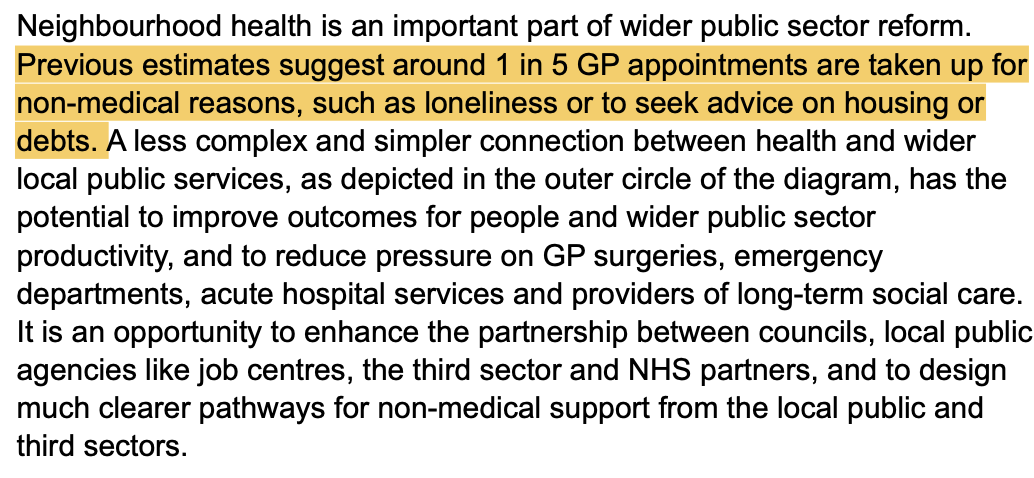
The guidelines call on NHSE regional teams to work with local government partners to agree locally specific impacts which they will seek to achieve in 25/6 – these to include:
- Improve timely access to general practice, urgent and emergency care
- Prevent long term and costly admissions to hospital
- Prevent avoidable long term admissions to residential and nursing care.
It is refreshing that the document has no mention of social prescribing!
Some thoughts
While there are great examples of Integrated Care Boards who have laid foundations for this agenda such as West Yorkshire and North East London – I think there are also a number who are off the pace. I do wonder if these guidelines flag up the beginning of the end for Integrated Care Boards given the need to push management resources to place and maybe put some of the resource into NHSE regional structures.
I think that we should expect to see an urgent refresh of management resources at place. These must have a much greater emphasis on relational and community development skills including a more sophisticated relationship with local government that strengthens local accountability and decision making.
At its core we should see an assertive shift of funding from hospitals to neighbourhoods and as part of this the VCSE such as community organisations and key players such as welfare rights providers.
This emphasis on neighbourhood and place also affirms the role of local authorities as key lynch pins in health and care systems, strengthening their responsibilities to commission key organisations such as local Healthwatch.
Actions to take?
As I flagged at the beginning I think it is key that local change agents ensure that these guidelines are used to created discussions at a place level which are about the actions and changes that the NHS needs to take to deliver on these.
In part they must be used to generate critical discussions – fundamentally they should be used to test whether Integrated Care Boards understand and act on the need for change that is required. Frankly, Integrated Care Partnerships should take a lead in ensuring these challenging discussions happen.
We should expect:
- Critical reviews of how fit for purpose the NHS is to deliver on these guidelines actions now and in the future – these need to be discussed publicly and developed in partnership with local government and the VCSE.
- These reviews should have at their core the voices of neighbourhood communities, primary care networks and the VCSE.
- The reviews should provide a foundation for place strategies that in the first iteration identify actions that will ensure that the workforce and local accountability are fit for purpose.
- Place based strategies need to have explicit budgets attached to them that link back to the guideline priorities.
What do you think?
 Local Democracy and Health
Thanks, Mark Thoughtful as always. There’s lots to like in the document but there are parts where they skate rather lightly over the capacity to deliver. Community health services in many areas are critically short of nurses, for example. Brilliant community support exists but it can fail through lack of one element such as someone qualified to prescribe and administer class A drugs for at-home pain management. (This kept two of my relatives in hospital rather than at home, both had social care support and community support arranged but without home nursing input the whole thing didn’t work.) The other issue in the mix now is devolution with the prospect of greater devolution of health budgets to come. I’m interested in how this will map to the ICBs and also how the citizen and community voice will be heard and be influential at this strategic level. Frances
Hi Frances – thanks for reading the blog and for your thoughtful comments – I agree completely there is a real issue with regard to the resourcing and capacity of community health services which will need to be picked up too. On your second point – yes I do think we need to understand how this fits with the government devolution agenda – I confess that I have not got my head around this yet. However, as I hint in the blog I do wonder whether ICB in their current form have much of a life when the focus has to be on neighbourhoods within unitary authorities. It might be better to shift ICB resources down to place and across to Mayoral Authorities? All the best – Mark
Mark, your analysis and response is widely shared, the NHS has decided to take in informed interest in “neighbourhoods” as an active player – and seems intent on delivering something tangible into this realm (which also connects NHS work to the local authority “Place” dialogue) however the new policy papers have arrived in a most difficult world, and with frenetic changes to the NHS leadership in the past few weeks.
My observations from working in both Provider and ICB roles in 2024, is that our current generation of NHS local leaders are pretty much battle hardened experts at crisis management: from recession to austerity to Brexit to pandemic to aftermath (more mental health need and sickness claims across all age bands), now on to elective waiting lists recovery and then a new government focussed on front end recovery of access targets. All with hardly any investment (capital) compared to previous eras. Few of our local NHS leaders have had time to do career apex CPD they normally would, or make the exploratory connections with local government or the voluntary sector that would underpin and inspire a bold shift to neighbourhood models.
I think the NHS needs to do some large scale organisational development with partners in neighbourhood spaces, at many layers. The work of Dr Bola Owolabi’s NHS Inequalities team has been a beacon of trying to link horizontally with new health actors. In recent weeks the CEO, CFO and Chair of NHSE have all announced they are leaving, and the incoming team are very focussed on improving the existing access targets by narrow, traditional means. This is obviously answering public demand, and an understandable political action, but doesn’t bode well for pushing forward on the creative thinking and new methods required to “do neighbourhood” really freshly.
The best work i’ve seen in neighbourhood brought to life over recent years has been in Coventry/Warwickshire (local carers and activists helping safely accelerate hospital delayed discharges with ingenuity, and consultant geriatricians offering direct liaison to attending ambulance crews to make bold decisions in the Frailty pathway, ie to not drag elderly patients into hospital when better local support can be assembled). in Dorset and West Yorkshire and Manchester there has been good progress on a range of services. And in the Black Country the mental health and learning disability/autism provider has a relationship with 400 different voluntary organisations, putting 10% of its Trust revenue (circa £25m this year) into multi-year grants with VCS organisations – who run crisis cafes, crash pads, 24/7 helplines, recovery support and more to augment the statutory services for 1.2m population.
The collectivist cultures of increasingly diverse populations in our West Midlands urban areas (especially Coventry, Birmingham, Sandwell, Wolverhampton) offer fresh models that ought to make different neighbourhoods offer even greater care pathway diversity.
Very exciting times, IF we have the leadership ready, the investment needed and the calm, generous pace to practice.
Jeremy Vanes
Hi Jeremy – sorry to be slow to respond – this is a cracking and thoughtful response – and very prescient given the latest announcements re NHSE and ICBs – but then I am sure that you knew that! Agree with you completely – one of the things that struck me in your comment above was the importance of mental health and learning disability commissioning/provision. In a small piece of work I am doing in Sheffield one of the things that struck me was that if we are looking for expertise in tackling health inequalities one of the first places we should look is at services working in that area…. I don’t think it happens systematically enough.
All the best
Mark