How independent should Directors of Public Health be?
In Healthy Lives, Healthy People the Governments Strategy for public health in England it says:
“The Chief Medical Officer will have a central role in providing independent advice to the Secretary of State for Health and the Government on the populations health”.
It also states that the new QUANGO Public Health England will “maintain the principles and practice of Independent Scientific and Public Health Advice… and it will maintain a source of independent expert advice through a structure of Expert Committees”.
Finally in the Annex to the Strategy it also refers to the role of the Director of Public Health – producing an “authoritative independent annual report” on the health of their local populations.
What a lot of independence! – if we add in NICE – who are also tasked with providing independent advice there are plenty of ‘independent voices’ out there. To summarise thats the – CMO, Public Health England, Directors of Public Health and NICE.
Public Health puts a lot of store in its independence – on the basis that equitable systems need to have means to raise population health issues that might go against powerful sectional interests such as those of the state or the market.
In these increasingly unpleasant times – 25% of the population are now officially in fuel poverty – the issue of independence has never been more important.
One of the problems is working out what this independence is actually for and how to exercise it effectively. Here are two examples
Example 1 – the letter to the Telegraph
In October 2011 some 400 mainly public health professionals signed a Public Letter published in the Daily Telegraph lobbying the house of Lords – asking them to reject the Governments Health and Social Care Bill.
Lets be clear – if I had been asked to sign the letter – I would have been happy to do so – I fully support the sentiments expressed.
The public response from Andrew Lansley was swift and brutal:
“We are very disappointed that these individuals, who pride themselves in the use of evidence, should have fallen back into such generalised assertions for which there is not one shred of evidence…NHS staff and the general public are looking to senior leaders in public health to lead the implementation of the changes to secure better health results for all, not to rubbish them.”
Behind the scenes some of the signatories were challenged by their managers and warned about signing such public letters.
I have worked in both forms of government in this country – Local and National and I do think that there are issues about when and under what circumstances it is appropriate to go public.
In my opinion most professionals get a big bite of the cherry to influence practice through the management structures in their own organisations and because of this I think that they are right to be restricted in what they can say outside of their organisation.
However, in these increasingly nasty times I know that organisations in all sectors are increasingly placing gags on all staff preventing them commenting on their organisations behaviour outside of work structures.
The only way that I can see that individuals can get around this – short of whistle blowing – is by signing up to a statement with another hat on – for example as a trade union member – rather than as an employee.
Now – what interests me is that none of the signatories to the letter signed it as members of their trade union – the Faculty of Public Health, Unison etc – but instead most signed it as employees of a range of (mainly) NHS organisations – as paid public health professionals.
Did their views represent their organisations views? Were the Chairs of the PCT Clusters asked first? I suspect in some cases they were but that in many cases they were not.
So is this an appropriate way for public health to exercise its professional independence?
My gut feeling is that it may have been better if they had signed the letters as members of the Faculty and other relevant unions rather than as employees of organisations.
This contrasts with the many letters signed by GPs – who, because they are by and large private sector small business people – can sign any letters they please in their paid capacity.
Example 2 – Director of Public Health Annual Report
The above example is pertinent because as Directors of Public Health move into Local Government a number have expressed their concern that they will lose their ability to be professionaly independent. At the moment many Directors of Public Health produce an annual report. The Health and Social Care Bill proposes that this independent Director of Public Health report will become a duty. I think that many DsPH are positive about this proposal.
I am aware that some Directors of Public Health currently insist on producing a public independent report that is not subject to any alteration by their PCT Chief Executive or Board. I am not sure that this is appropriate either. It seems to me – that in local government any report produced by local authorities must be owned by local politicians – in other words the cabinet or full council should have the right to change or veto content.
As far as public health is concerned this context is important – because the DPH should be using the report to influence the thinking of elected members and hopefully through this develop a consensus view of issues and priorities.
In the unlikely event of a disagreement between the DPH and the council cabinet there are a number of checks and balances which will include – the local authority scrutiny committee, Healthwatch and the Health and Wellbeing Board – the DPH should ensure that all are involved in drafting and commenting on the report.
The key issue is creating a platform for debate and dialogue – bringing together professional analysis with local realpolitik – to create opportunities for action.
It is essential that DsPH use this independent report to build strong alliances with local authorities – because we can be sure that the Department of Health will be pulling the strings of Public Health England and we will continue to see the sort of behaviour by DH as described in example one.
So here are some actions we need to start to take:
- The Faculty and the Association of Directors of Public Health need to provide more opportunities for the public health profession to work together through collective action.
- In an increasingly politicised public health environment we need to consider carefully what independence actually means with regard the CMO, PHE and DsPH – and in particular when is this an individual and when is this a collective responsibility.
- As PH moves into local government DsPH need to be supported in taking a nuanced and tactically astute approach to exercising their independence that builds collaboration and alliances within local government – particularly at an executive and elected member level.
- Directors of Public Health need to look outside local government and consider how they can support – and I mean with money – genuinely independent voices that represent the interests of communities of geography and interest. Such as Community infrastructure organisations, Health Champions, Trade Unions, Citizens Advice Bureau and others.
What do you think?
Volunteering and Health a missed opportunity – Department of Health Strategic Vision for Volunteering
 Its hard to get people engaged with your vision if you are not honest about the challenges that we face and clear about where you think we should get to.
Use of words
The titles that governments give to policy documents give a good clue to how important they are felt to be. So when a document has the word “Vision” in it you need to read carefully – civil Servants tend to use the “Vision” word when they have struggled to get clear ministerial commitment to action.
A touchstone of this government has been its active promotion of the ‘Big Society’ (note this link to the Big Society no longer mentions the ‘Big Society’ the term has largely disappeared from Government policy although the awards continue) – active and engaged citizens; a rebalancing of the relationship between the state and the citizen; Less top down; less big brother; more freedom and responsibility for communities and individuals.
So – this strategic vision should be a key document – after all the Department of Health is one of the governments biggest hitters – the second largest department by spend. You might imagine that when DH takes an interest in volunteering everyone stops and listens – you should be able to hear a pin drop.
Unfortunately this report is disappointing. Although it says it is aimed at leaders it is really more of a primer on volunteering and health – much of what it says will be of interest to junior managers in the health system who are new to developing community services – this is no bad thing in itself – but it is not the leadership we expect from a Government Department.
This lack of serious ambition and challenge can be taken as an indication of the lack of interest from key ministers – Paul Burstow and Andrew Lansley in this agenda. It is not the responsibility of the tiny DH Voluntary Sector and Big Society Team – who have clearly done their best to make the most of the limited mandate that they have been given – the fact that it has come out at all is an achievement. You can get a feeling for how difficult even getting it out must have been because one of the key actions promoted by the strategy is to support the European Year of Volunteering – the strategy came out 2 months before it ends!
3 Indicators of Disinterest
What do stakeholders say?
Have a look on the web – I have scoured the web for a comment on this document and found very little – aside from short factual statements – the best of which is that on the Volunteering England Website (no online) – which focussed on the very small amount of funding – £2.4m available for 2012/13. The Kings Fund aren’t interested, neither is NCVO or ACEVO. Of equal concern – given who the policy is aimed at – there is not a flicker of interest from the NHS Confederation or the Local Government Association.
What does DH say?
Have a look at the references in the document – this gives you a feeling for how seriously the big hitting directorates take this issue at the moment. There is only one direct reference to an existing mainstream DH policy – The Mental Health Strategy. It has clearly not proved possible to make a connection with mainstream DH policies that are central to the work of the NHS, Public Health and Adult Social Care.
This is an indication of how peripheral the volunteering agenda continues to be to DH.
Whats the problem?
At the moment the voluntary and community sector are getting thumped by government cuts. In Yorkshire and the Humber alone INVOLVE the excellent regional voluntary sector infrastructure (closed down due to cuts in 2015) organisation tells us in its 7th Quarterly Confidence Report that:
“More than 70% of respondents think that general economic conditions within the voluntary sector will continue to deteriorate. Interestingly, nearly half of these respondents expect their local authority to be a positive influence to their organisations success while more than a third expect central government departments to have a negative influence.”
Its not just about the voluntary sector itself – as the report acknowledges – the number of people who are volunteering has actually gone down. The Governments last (in both senses of the word) Citizenship Survey tells us that:
- Thirty-four per cent of people said that they had engaged in civic participation at least once in the 12 months prior to interview. This figure was unchanged on 2009-10 but lower than in any year before then (between 38 per cent and 39 per cent).
- Twenty-five per cent of people reported that they volunteered formally at least once a month in 2010-11, a lower rate than at any point between 2001 and 2007-08 (when it ranged between 27 per cent and 29 per cent), but unchanged on 2008-09 and 2009-10 levels.
So – we have a local voluntary sector under extreme stress, a decrease in volunteering and a Government Department whose mainstream policies pay little attention to volunteering.
These are the challenges the document needs to get to grip with – and it does not – and equally dispiritingly it offers little idea of how society might look if this “vision” were realised.
Whats positive in the document?
The Questions
The document is structured around 4 sections – Leadership, Partnership, commissioning and Volunteer Support. At the end of each of these are set of questions that local players might ask themselves. They are quite helpful although too often a bit wet – after all this is a document that says it is “aimed at leaders and decision makers” these people expect to be asked tough – hard nosed – strategic questions – if they aren’t they lose interest. So some of the questions I would be tempted to ask are:
- Do you know the extent of volunteering in your community….in detail?
- How many of your service pathways involve volunteers at a system level…where do you set out your ambition for services to involve volunteers?
- What is the extent of grass roots volunteering in your community and what are you doing to strengthen it?
- What work are you doing to rebalance services to place less emphasis on professionals and bring them closer to communities?
- Do you monitor the state of health of the voluntary and community sector in your community? This is quite achievable by the way – here are some examples from the yorkshire-and-the-humbermapping-report1412101-mc-final:
Number of 3rd Sector Organisations per 1,000 population
- Craven – 6.99
- Calderdale – 3.01
- Sheffield – 2.62
- Wakefield – 1.76
Helpful Actions?
Here are some of the actions that the document proposes that feel helpful (and it is slim pickings) and the questions they prompt for me.
- Evidence – A commitment to work with partners to develop the evidence base
- Question – how much funding is DH committing to this over the next 3 years?
- Resources – Targetted resources to promote volunteering in health, public health and social care
- Question – will DH commission these directly from the Voluntary and Community Sector; DH has had a good tradition of doing this.
- Discussion – Facilitate discussion on key issues and improved access to information
- Question – excellent – How much funding is DH going to put into this?
- Facilitate improved access to information and good practice
- Question – will this include national data that can be interpreted locally on the extent of volunteering
- Health and Social Care Volunteering Fund
- Question – what is the level of funding that will be available over the next 3 years?
Finally – Actions that are missing.
- DH Voluntary Sector and Big Society Team
- Question – how much investment will be going into this team over the next 3 years to ensure its work is sustained and strengthened?
- Mainstream DH Policy
- Question – what actions will DH be taking to embed work on volunteering at the heart of Public Health England, the NHS Commissioning Board and work on Adult Social Care?
A local government public health?
Supplementary
I missed the Public Health Joint Statement 14 October 2011 produced by the LGA, Assoc of Public Health, NHS Confed, Faculty of Public Health etc. This is very relevant to the subject below and gives a useful bit of context. If anything it reinforces the points below – it is also worth having a look at Trevor Hopkins response to the blog in the comments below.
Original Blog
I am involved advising a couple of local authorities who like all unitaries are considering what public health might look like in the new world. As I have said in an earlier post – if we are to make the most of this transition we need to recognise that there will have to be a substantial cultural change in the way in which public health currently works. One of the challenges though is how radical can local authorities afford to be at this moment. They need to set the tone for the future, but not destroy what is good or frighten off an already jittery public health profession.
One of the difficulties is knowing where to turn to for advice – the Faculty of Public Heath is in effect a craft guild whose primary concern is to protect the profession it has created – and there is nothing wrong with that. The problem arises when Local Government and National Government need independent advice. Advocating for the public health profession is not necessarily the same as advocating for a effective public health in local government terms. Of course the Department of Health has the same problem – it remains very reliant for advice on an embedded faculty function. This means that local authorities need to quickly come to a view themselves about what Public Health should look like.
Here are some of things that local authorities are considering at the moment.
Questions 1 and 2
Two of the questions a local authority councillor needs answering when they are required to take on responsibility for a new service are:
- what am I legally required to provide? and;
- how much will it cost?
Once they are clear about this they can then work out whether they have any resource to deliver more than the statutory minimum and create a service that also reflects local priorities and need.
Of course these questions becomes much more pertinent when times are tough. For example – there is a statutory duty for local authorities to provide library services – which requires all local authorities to provide a comprehensive and effective library service, set in the context of local need.
However closure of a number of libraries to ensure better, more efficient services does not mean that local authorities are in breach of the Act – as the residents of Brent have recently found out. This subsidiarity of local government will be further strengthened by the Localism Bill which proposes a general power of competence – local authorities are free to do anything so long as they don’t break any laws. This is of course a double edged sword – they can respond to local needs and priorities – but it is all within the context of government policies – in particular funding regimes.
You can see where I am going with this. I have not been able to find anything that clearly states what local authority public health duties will be after public health departments have transferred over AND who MUST be employed to deliver on this duty and how MANY of such people there should be.
Frankly, in the world of publicly funded services there needs to be a clear argument why certain skill sets are required to deliver certain statutory functions and I have not seen those arguments presented – in public health. If there are no clear arguments to be presented then I think it is perfectly reasonable for a local authority cabinet lead to argue that they could purchase the same skill set for half or two thirds the price of a person with a Faculty of Public Health badge.
I would be really interested if someone can point me at the legislation and associated guidance that spells this out.
Question Three
“I thought you were a public health department – but you seem to be passporting a whole load of NHS treatment services over to us?”
I have been quite suprised to see that a large part existing public health budgets – in some cases 50% – to be transferred over to local authorities is for NHS treatment services. Specifically drug treatment and STD services. I know that an element of these is for population level prevention measures but I think that the bulk of this is for treatment of individuals.
I think this is a mistake for two reasons.
First, expertise for the management of treatment services such as GUM services rests inside the NHS and accountability for their performance should rest there too.
Second, the small public health function in local government needs the management headroom to bring added strategic impact to its work with local government. One obvious way to do this is to free up management time by getting rid of clinical responsibility for treatment services and refocussing this capacity to work more with local government.
If this does not happen there is a real danger that the new local government public health function while being based in the local authority will continue to be distracted/seduced by the pull towards NHS clinical responsibilities.
What do you think?
Local Government and a new Public Health
 In an earlier post I touched in passing on the fact that the emphasis of current reforms seems to be more on the administrative issues associated with the move of public health to local government – finance, where DsPH will sit in the local authority that – sort of thing.
There seems to have been very little thought given to whether the public health function is actually fit for purpose or not. There is a cracking article by Richard Horton which touches on some of these issues. It’s on the Lancet website (www.thelancet.com Vol 378 September 17, 2011) or if you are not registered – I have made it available here – Future of Public Health Richard Horton.
The quote I really like from Richard Horton’s article is:
“Public health is the science of social justice, overcoming the forces that undermine the future security of families, communities, and peoples. Public health leadership in England is failing. It is time for those leaders to discover courage and purpose.”
This article is complemented by a series of papers commissioned by the excellent Healthy Communities Programme that was run by Local Government Improvement and Development (LGID). This programme has been the national leader in creating a forum for inclusive mature debate about the future of public health. There was a community of practice linked to this but it no longer exists in this form since the disappearance of this organisation.
The papers reflected a diversity of views about what public health should be in the future. Some continued to make an argument for the broad and technical role of the DPH while others focused more on the need to reinvent public health to capitalise on its new position in local government.
There are lots of papers and I have not read them all yet – but I would recommend those by David Hunter and Phil Coppard.
Some opinions.
I regret to say – with some notable exceptions I have met too many very well paid public health professionals who don’t seem to be comfortable with the principles that Richard Horton sets out above. There is a school of thought prevalent in the English public health mainstream that sees public health specialists primarily as skillful technicians able to use a variety of sophisticated technical interventions that can reduce smoking, decrease obesity etc without worrying to much about improving peoples circumstances or life chances.
This apparent scientificity validates an approach that believes technical interventions can solve health inequalities and that unfair health outcomes have little to do with the distribution of wealth and power.
I think that the move into local government is going to expose this delusion pretty quickly for a number of reasons – here are my top 3.
Making a political stand for citizens – Local Government has spent over 100 years refining the way it works so that it can respond to the needs of its citizens. structures to respond to the needs of its citizens. At their best political leaders will put themselves on the line to defend the wellbeing of their electorate. Evidence? – Clay Cross and all the local authorities who took a stand over ratecapping.
Accountable for fair services – Councillors are acutely aware of the need to justify salaries of highly paid staff to their local electorate. One of the ways in which they defend the high salaries of their top staff is because they are responsible for large budgets, very big staff teams and are personally held to account when these services fail. There are many of examples of local authority directors who have had to take ‘the long walk’ when they have failed – particularly when this failure has affected the most vulnerable.
Making an impact – Leaders in Local Government have to be able to demonstrate that through their leadership they make a positive difference to local populations – if they are not able to do so then the question has to be – what added value do they bring and can their salary be justified.
The irony is that a good number of professions in local government probably owe their genesis to public health – for example local authority Directors of Housing Services. The challenge now is to demonstrate what added value Directors of Public Health bring given that many current local authority directors already work to a set of standards that they would argue improves health and wellbeing. Public Health needs to prove that it is as relevant now as it was at the start of the 20th Century, and frankly compared to some of the local authority big hitters (housing, social services, education) public health struggles to demonstrate impact at the moment.
So what offer can Public Health make in Local Government? Three possible actions.
Empower the politicians – Unlike Non Executive Directors in the NHS local councillors represent their electorate – this means they know that they have to go out into communities and engage and develop a shared sense of what a particular place should be like. Directors of Public Health have a tremendous opportunity to support and empower politicians in providing a strong and inclusive vision for their community. Part of this will of course be about empowering councillors to take the fight back to central government too.
Managing Services – Directors of Public Health are in a great position to take responsibility for the delivery of large-scale services that impact on wellbeing. They can now play a key role in rebalancing commissioning placing a greater emphasis on services that are a prerequisite for wellbeing. Championing housing security (or even managing housing services!), ensuring that welfare rights services are available to all who need it (maybe leading commissioning of these) or championing the commissioning of careers services to improve social mobility. This is a tremendous opportunity – rather than fiddling about on the sidelines trying to persuade people to stop smoking when they are in problematic debt – or focussing on healthy eating in school when the number of young people who are Not in Education Employment or Training continues to rise.
Impact – In local government the DPH will be able to take direct responsibility for improving the wellbeing of whole populations. For example with regard to physical activity – they will no longer be constrained in just focussing on commissioning a few healthy walks programmes for people with long-term conditions – they can lead approaches that span transport, leisure, culture and health and spatial planning – creating powerful holistic cultural change that could improve all of our lives.
Moving into local government offers a real opportunity to create Public Health 2; “New Public Health”; call it what you will. There is a real opportunity and imperative to reshape public health so that it is ‘of local government’ and not ‘of the NHS’. But Directors of Public Health will need to have the ‘huevos’ for it, it’s about engaging wholeheartedly – and almost certainly discarding ambitions to be the clinical leads for public health in the NHS. Leave that for the clinical technicians!
Healthwatch Consultation – its not just about the money honey
 Lets get my cards on the table.
First, I think investment in mechanisms to help citizens hold local commissioners to account is a GOOD THING.
Second, efforts that we have made so far to do this – Community Health Councils, Commission for Patient and Public Involvement in Health and LINks have all been a bit wet. In all the turbulence since the election the voice of LINks – the key agency for getting the citizens voice heard has been almost completely absent from the debate about the future of the NHS, the role of public health, the impact of policy on health inequalities – etc etc.
I don’t want to decry the achievements of LINks – in the DH annual report for 2009/10 there are interesting examples of success – not least some evidence of successful service change and of savings achieved.
As we move towards October 2012 and the implementation of Healthwatch we need to make sure that the debate about its contribution is powerful, lively and public. Will the proposals put forward by DH allow local authorities to build on the successes of LINks and move to more powerful engagement with citizens? We certainly need it to.
I suspect I will return to this issue – but for this posting I am just going to consider the money – as this is the subject of the very narrow “consultation on allocation options for distribution of additional funding to local authorities for Healthwatch etc” that the Department of Health is currently running until the 24th of October.
The consultation seems to me to have two purposes one explicit and the other implicit. It explicitly puts forward for comment two methods of calculating funding for Healthwatch, NHS Complaints Advocacy and PCT Deprivation of Liberty Safeguards. It also brings together these three areas in one consultation – implicitly raising the question about whether these functions could be commissioned from one organisation.
To be honest I am not really interested in which of the two models that DH puts forward for calculating local allocations is the right one – they both reach roughly the same figures – and I don’t think that is where we should be spending our energy.
We have to be thinking about what Healthwatch is tasked to do and what it needs to do to achieve this – the money follows.
Some figures from the consultation
Existing LINk funding £27m
Signposting funding taken from PALs £19.3m
Additional Choice Money £.5m/1m/1.5m per year from 2012 onwards.
Some start up money £3.5m – first year only
I am not going to talk here about other funds which are also included in the consultation (DOLS, IMHA etc)
The funding equates to roughly £47m a year. In the absence of any clarity about what a good model looks like DH have presented us with the two formulae in the consultation. While superficially this appears objective and evidence based I don’t think it is good enough. This is because the models that DH use for calculating investment in Healthwatch bear little relation to the challenges we face which include:
- a new health system which will require very strong local organisations holding Clinical Commissioning Groups to account
- greater focus on providers to ensure that they do not reduce quality as they try to cope with government spending reductions.
- the need for an even stronger focus on wicked areas such as health inequalities
- the need for strong advocacy at a national level to hold the government to account for their drive to marketisation
If government ambition is to be met and if health and well being services are to be protected and improved we will require Healthwatch to deliver a well informed and active citizenry who are engaged to a degree that we have not seen before.
So, lets compare the proposed funding against a model that has been running since 1939 – Citizens Advice. I am using this for two reasons – First, because the government has said that Healthwatch should become more like a “Citizens Advice Bureau for health and social care” (DH consultation – Liberating the NHS Local Democratic Legitimacy in Health) and secondly I know a bit about it having been involved in CA at a local and national level for some time.
Local Citizens Advice Bureau funding in 2009/10 was £179m with a further £62m going directly to the national organisation. In that year Citizens Advice organisations helped over 2 million people – this compares to 192,000 seen by LINks in 2009/10. (Note that in addition to Citizens Advice there is also a large network of independent advice centres who are affiliates of Advice UK). Of the 28,000 or so staff employed by Citizens Advice about 75% are volunteers – who have access to high quality training and development support.
In simplistic terms the Citizens Advice network provides two services – helping individuals with their problems – welfare rights, debt advice, signposting, advocacy AND analysing the 1:1 support it gives – to inform its social policy campaigning nationally and locally.
There are of course no figures on performance for Healthwatch – yet. My argument is that Citizens Advice data – on cost and service start to gives us some clues about how we could develop a stronger model for looking at cost.
A stronger model for resourcing Healthwatch?
First – are we expecting Healthwatch to provide a similar service in terms of population coverage to Citizens Advice – if so, then why is Healthwatch funding only just over 20% that of Citizens Advice? Is this because it will be seeing fewer people? what it does is less complex? It has less of a role as a social policy champion?
Second – is it realistic to expect Healthwatch to offer a similar range and quality of service to Citizens Advice? If so then it is worth considering the CA service model which has elements that include:
- an integrated approach to service that ranges from national web based advice and phone advice lines to local face to face provision
- a national membership system which provides quality assurance, training, access to specialist advice etc
- a standardised IT system that allows data to be aggregated and quality assured at a national and local level
- a powerful independent national policy function that can speak strongly and independently about government policy
Third – if we accept that the above makes sense are the current proposals about investment sensible? For example it seems strange to develop and consult on the funding allocation at a local level without considering the resource implications for the whole system – what will CQC provide and how much will it cost?
So – as we move towards the commissioning of Healthwatch – I remain concerned. I think that DH offers us a financial model that is based on data that has weak links to the new role of Healthwatch, does not include adequate clarity about the role and functioning of national Healthwatch and does not seem to build on existing experience and practice of agencies who have been working in this field for a considerable period of time.
What do you think?
Lets get started – here are quotes from 2 influential women – who are both concerned with the quality of family life.
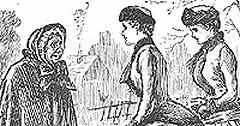
First, Mrs Beeton – here is an extract from her great book on Household Management published in 1861.
“Visiting the houses of the poor is the only practical way really to understand the actual state of each family …
Extending charity and benevolence to neighbours – Punch 1894
Great advantages may result from visits paid to the poor; for there being, unfortunately, much ignorance, generally amongst them with respect to all household knowledge, there will be opportunity for advising and instructing them, in a pleasant and unobtrusive manner, in cleanliness, industry, cookery and good management.”
Second – Emma Harrison owner of A4E, multi-millionaire and founder of Working Families Everwhere (WFE) – this time on her website Working Families Everywhere.
Note that this initiative appears to have died completely – there remains a rather dead Facebook page here – which has had little activity since 2012.
I have slightly abridged this quote from the original – now defunct website.
“In December 2010, the Prime Minister David Cameron asked Emma Harrison to lead a drive to get troubled families working again. This initiative is focussed on the “100,000 never worked” families. These families will have their own champion who will help them “face up to and sort out their problems, whether they be parenting challenges, poor health, debt, addiction, dependency or lack of motivation. Most importantly, it will involve helping people into meaningful employment to help create happy, working families with a new sense of purpose and an active role in society.”
With the strong backing of David Cameron she will ensure that this project is “highlighted in the media”. She also commits to “inspiring, recruiting, training and developing an army of “Emmas” who will be from communities up and down the country- people who are passionate about and capable of helping others.”
Health Inequalities and Communities
WFE had a high profile with the media with ambitions to reach 100,000 of the most socially excluded families and close links with the Prime Minister. It is a real challenge to those of us involved in such programmes as Health Trainers, Community Health Champions, and Community Development Initiatives such as the Health Empowerment Leverage Project pioneered by Hazel Stuteley.
What is the problem?
For many of us who have worked in the public health/heath inequalities field one of the reasons that we continue to fail to reduce health inequalities is because there is insufficient political pressure at a local and national level to bring about sustainable and long term change to society and public services. Instead governments and commissioners have relied on narrow strategies focussed on doing things to the poor – such as targetting clinical interventions at the most disadvantaged or lecturing them about their diets. This has not worked – services still bend towards the middle classes and people still prefer chips to the mediterranean diet.
Initiatives such as Health Trainers, Health Champions and HELP take a different approach – working alongside communities – helping them build on their strengths, and by so doing supporting them in influencing services and developing new ones. They place a huge emphasis on peer led change at both an individual and community level, and try to recognise the political (with a small p) dimension to this change.
Increasingly these programmes are able to demonstrate success – very often helping people to improve their personal circumstances – often through employment or training, but doing so in a way that starts with the challenges that people face and through support from their own communities.
Superficially WFE appears to have similarities – it aims to bring people into a relationship with a dedicated volunteer exemplar who has three key characteristics (Caring, Capable and Creative) and who will put the family they are supporting onto the path to employment and integration into society. Sorted!
Concerns
First – the focus of our work through health trainers, champions and so forth has been about building on strengths within communities – not through parachuting middle class champions in. This is harder to describe and a slower process but works from where people are and does not see them as “not having a clue what to do next”.
Second – our approach has a starting point which recognises that people are rational and will want to focus on issues that are of immediate concern to them. We do have evidence that in many cases this leads to people becoming employed – but the point of connection initially may have been something completely different – attending a health walk, solving a debt problem or becoming involved in a social activity. My impression is that WFE is instrumental – its main focus is employment and this is not for negotiation
Third – I don’t think that WFE is interested in the political dimension of peoples experience. Central to community health champions and HELPs work is the idea that empowered citizens are ones who will become engaged individually and collectively in seeking to improve conditions and services for their communities – the WFE model does not seem to offer anything here.
So what does WFE mean for us?
First – Emma is clearly a fantastic publicist and has done a great job cultivating David Cameron. The WFE model is attractively simple, has a great fit with the ‘Big Society’ agenda and appears to be cheap. Despite years of plugging away we cannot claim that Health Trainers, Community Health Champions or Connected Communities has the same degree of ownership at the top of Government. Ironically all of these programmes have played the game – piloting, evaluating, producing the evidence – yet despite the Governments commitment to evidence based policy making – it only seems to require a charismatic millionaire to come along for that to be be put to one side.
Second- the three WFE pilot sites are Blackpool, Hull and Westminster. Coincidentally these are all Community Budget sites who along with 13 other areas now have a dedicated budget – a ‘local bank account’ for tackling social problems around families with ‘complex needs’. By focussing on these WFE places itself and its parent organisation A4E in a good position to do what it does best – winning government contracts – in addition it will be well placed to access funding promised through social impact bonds.
This expertise in winning contracts could represent a real challenge – at a time when health trainers, health champions etc are making the case for funding locally.
I am actually not convinced that WFE will succeed – but with the energy, money and charisma of Emma behind it plus David Camerons support it will at the very least prove an unhelpful distraction for a couple years.
So what should we do?
I think that it is really important that we develop a clear position here and set out our stall. There is a risk that if we do not policy makers and commissioners will be seduced into thinking that this attractively simple proposal led by a charismatic millionaire from the private sector is the answer, and the evidence and good practice that we have spent years developing will just be ignored.
So when services are commissioned Health Trainers, Community Health Champions etc will struggle to demonstrate impact against more simplistic solutions like WFE.
We need to to speak powerfully to policy makers national and commissioners locally not just about individual programmes and projects – but offering scalable service models that provide a genuine alternative to WFE.
The emerging think tank on Active Communities for Health being co-ordinated by Leeds Metropolitan University and Altogether Better provides a good start. This will seek to bring together national organisations with a track record in community engagement and health.
 Its worth having a look at the talk given by Professor Mike Kelly who was the Director of Public Health Excellence at the National Institute of Health Clinical Excellence (NICE).
This talk was given at the Public Health System Reform Summit organised by the Kings Fund last month. It provides a helpful insight into the strengths and weaknesses of our current approach to evidence based public health commissioning in England.
Mike is a superb communicator for NICE – and his description of the health inequalities challenge that we face and our failure to close the gap is well put.
From what I understand of his argument he is saying that we have the evidence – the problem is its effective implementation. I think he goes on to say that he believes that there needs to be further work (by NICE) to bring a greater degree of detail (he calls it granularity) so that the evidence can be used to drive the practice of particular professionals in particular circumstances. The example he gives relates to the different roles of people in primary care with regard to helping people stop smoking.
Now I am not going to critique “brief interventions” here – I will leave that for another time.
What I am concerned about is the way in which government places NICE evidence as a gold standard which should drive our approach to public health decision making – particularly with regard to tackling health inequalities – I am not convinced that this is right.
First a bit of context – NICE occupies a unique position in the governments policy landscape. As Mike says in his talk – “Healthy Lives, Healthy People” the Governments Strategy for Public Health in England affirms that Public Health England will:
“Ensure that the National Institute for Health and Clinical Excellence (NICE) adds maximum value by providing authoritative, independent advice on the evidence of effectiveness and cost effectiveness for public health interventions, working to specific commissions from Public Health England.”
And in footnote 106 of the same document (bear with me these things are important) he reminds us that:
“The National Institute for Health and Clinical Excellence has developed a way to conduct cost impact and return on investment calculations to accompany its public health and social care guidance and quality standards. This could provide the basis for decision making and priority setting at a local level by GP consortia and local authorities, enabling effective commissioning by Directors of Public Health”
So what does all these mean? Well, these two paragraphs anoint NICE as the lead agency for providing evidence on cost effective commissioning on Public Health to the NHS and to Local Government.
None of this is a problem – so long as – first – the quality of NICE evidence is of a sufficient standard to “enable effective commissioning” and second – the “specific commissions” by Public Health England actually focus on the real causes of health inequality.
So first, is NICE evidence good enough to help us reduce health inequalities? I am not convinced. My concern stems from Kings Fund talk. A focus on granularity – on the detail. This approach is equivalent to trying to trying to reduce carbon emissions by getting everyone to tune their car in order to reduce fuel consumption. The evidence base for tuning is probably solid but it makes little difference in the long run – the real strategic commissioning decision in this example is much bigger its probably about – increasing cycling, walking, use of public transport etc.
The NICE tendency – to focus on very small measurable interventions is historical. Its where the organisation started – assessing the cost effectiveness of drug therapies and surgical interventions. These can of course be measured and evaluated in a much more controlled way.
The problem arises when the same approach is taken to interventions to reduce health inequalities at a population level. The NICE model drives us towards the small scale, away from populations and towards interventions that are led by clinicians – it drives a medical model of health – it may be the most cost effective clinical intervention that has been tested – but that is all it is. It is not necessarily the most effective intervention.
Here is a not so hypothetical example.
Money is tight – a Director of Public Health goes in to see their new Cabinet Lead for Health. The councillor says – “the government continues to cut our core funding and I therefore need to save £2m. Give me your advice I have two services which need funding – one is a smoking cessation service – who are working according to NICE guidelines. The second is a welfare rights service – all of whose clients have chronic mental health problems with a very high proportion experiencing problematic debt and fuel poverty. I can only invest in one service – where should I invest the £2m – which one will make the greatest impact on the health and well being of the most disadvantaged?”
What advice can NICE offer these two people? My concern is that if you rely on NICE guidance this pushes us to where the evidence base is more complete – the smoking cessation service – so we end up with an approach to public health commissioning that only funds services where there is a NICE approved evidence base – even if – like smoking cessation – the services are not actually very effective or relevant if compared against services that people really really do rely on like welfare rights provision.
For example I cannot remember the last time I saw a queue of desperate people outside a smoking cessation service – something that is common place with welfare rights services.
So – I think that if NICE are to be a genuinely powerful force for good commissioning they need to do the following:
First – have a bit of humility – most commissioning decisions in public health rely more on the experience of DsPH, other professionals and Elected Members than they will on NICE guidance – there are too many variables and not enough researchers. Lets acknowledge this a bit more – it will actually empower stakeholders for NICE to be saying this loudly and clearly at the front of every bit of public health guidance it produces.
Second – it would help if NICE focussed a bit more on broader strategic commissioning issues and less on the micro – less granularity please and more broad messages to commissioners.
Third – NICE is meant to provide independent advice. This only has meaning if it offers (where appropriate) challenge, otherwise why be independent? NICE does this well when it comes to challenging government policy on medicines, it needs to use its powerful evidence base to challenge wider government policy with regard to its impact on health inequalities. So more engagement with government policy impact assessments would be good.
Fourth – NICE needs to set its own evidence agenda more – and be less reliant on commissions from Public Health England – this could be awkward for NICE because in my view it means a move from the apparent scientificity of its work to a more political analysis of the causes of health inequalities – but lets face it when you are producing evidence on tackling health inequalities – it comes with the territory.
Finally – for all of us – it is really important to confidently stand back and assess NICE guidance – does it really help? What is the paradigm it is working in? Lets be less slavish about the evidence and more confident in our own expertise and experience.
As Public Health goes through a further spasm following the launch of ‘Healthy, Lives, Healthy People – Update and way forward” (HeLPU&WaF) it would be easy to think that its content describes some of the main business that we need to be focussing on for the rest of this year.
Nothing could be further from the truth – public health is moving to local government (hurray!), there is a bit of finessing around the edges – the relationship with NHS England and where various important but small services should go – but its not where we need to keep focussed. Lets face it the main purpose of HeLPU&WaF is to re-assure the public health professional that they will still be loved, respected and (well) paid in the new world.
HeLPU&WaF speaks to a very small section of the public health workforce. Those organisations who are working on the frontline – the voluntary sector in particular – will feel ignored and dispirited by this inward looking document.
In the same week that HeLPU&WaF was launched the Cabinet Office launched their White Paper “Open Public Services”. It is interesting that health inequalities is well to the fore here.
“In 2003, the Department of Health created 82 ‘indicators’ to measure factors that would contribute to reducing health inequalities: by 2006, departments had met 72 of them, and yet health inequalities continued to widen.
In England today, people living in the poorest neighbourhoods will, on average, die seven years earlier than people living in the richest neighbourhoods”
In part health inequalities is probably mentioned because it suits this government to use areas of previous policy failure to justify the marketisation of NHS and other services. Nonetheless the statements are strong and there is even a reference to how a “local authority could use a local social enterprise to help cut obesity rates.
This White Paper represents the polar opposite of HeLPU&WaF, it sets out a high level direction of travel, is thin on detail and has ambitions to be genuinely whole system. I think it has the potential to be a much more powerful force for good or bad than the over designed machine that will become Public Health England.
In some work that I have been doing with Voluntary Sector North West it is clear that there are a wide range of innovative place based voluntary organisations working who are demonstrating substantial impact on key public health problems – from debt, supporting people manage chronic mental illness to tackling smoking and sexual health problems.
If you want to know more about these check out:
All of these organisations have established powerful relationships with local commissioners, relationships that have often been championed by local public health leads – usually in health promotion. They also have hard earned links to the communities they serve, whole system solutions and strong evidence based interventions.
It is the local systems that have enabled organisations like these to flourish that DH should be promoting in HeLPU&WaF – they have an essential contribution to make to a redesigned public health system that can address health inequalities more effectively.
Instead, DH looks inwards and it is other government departments who are making the running on setting up systems that could impact powerfully – positively or negatively – on inequalities.
Some final scores
| Department | Document | Health Inequalities Mentioned | Voluntary Sector Mentioned |
| DH | HeLPU&WaF |
6 |
0 |
| Cabinet Office | Open Public Services |
4 |
9 |
Housing Benefit and Health Impact Assessments
 The review of the Governments approach to Health Impact Assessments carried out by the Centre for Health Impact Assessment (which is part of the Institute for Occupational Medicine) supports my superficial investigation into health impact assessments that I described in my earlier blog.
Their review “Putting Health into the Policy Picture” looked at over 300 government impact assessments – all of which had been commissioned as part of the process of developing policy or piece of legislation.
The study discovers significant variation in quality; a small number of impact assessments do have a good health focus but a lot show little evidence of systematic consideration of health impact positive or negative.
The report also expresses concern about the capability that exists within government to ensure that high quality health impact assessments are consistently carried out.
I do think that one area that the review does not address properly is the relationship between the impact assessment and those outside of government. There seems to be an assumption that impact assessments are primarily an internal process – through which technically astute, professionally trained ‘experts’ can bring their technology to bear to stress test policy change.
We need to challenge this assumption.
Territory to fight over
Impact Assessments should provide an important place for stakeholders outside government – local authorities, the voluntary sector etc to challenge and debate with government – this is territory to fight over. I do not get any impression that Government – in particular the Department of Health – pro-actively encourages key stakeholders to use the material in impact assessments to have a public debate about policy impact. Similarly I am not aware of public lobbying using impact assessments as a mechanism to challenge and influence policy makers.
I think that this is because Impact Assessments and Health Impact Assessments in particular remain obscure and rather technical documents – rather than a key lever to improve policy through widening and strengthening democratic engagement.
What can be done.
While it would be great if Government were to improve the way it does impact assessments – we can’t wait – action needs to be taken outside government – national voluntary organisations, local government and academia all need to become more proactive in challenging impact assessments that relate to their areas of special interest.
Engagement must not just be through formal government channels – but publicly through the media. That way we will have better informed debate and will empower those civil servants within government who want to deliver better policy that improves wellbeing.
Housing Benefit cap
Is this such all such a big deal? Well – the government is pursuing an aggressive set of policies which have the potential to hit the poorest hardest. The proposals in the Welfare Reform Bill to cap Housing Benefit – which could lead to a large number of people having to leave their homes has hit the press recently. If you look at the relevant Impact Statement linked to the cap on Housing Benefit – it says that there are NO impacts on Health and Wellbeing.
As we now know on the 2nd of July the Observer published a leaked letter by Nico Heslop (private secretary to Eric Pickles Secretary of State for Communities and Local Government) where he writes to the Prime Minister and says
“……our modelling indicates that we could see an additional 20,000 homelessness acceptances as a result of the total benefit cap. This on top of the of the 20,000 additional acceptances already anticipated as a result of other changes to Housing Benefit. We are already seeing increased pressures on homelessness services. I understand that there may be a suggestion around requiring families to divert a percentage of their non-housing (benefit) income to cover housing costs. It is important not to underestimate the level of controversy that this would generate (likely to dwarf anything already seen on the HB only caps) and the difficulty of justifying this in policy terms as well as implementation.”
No impact on health and wellbeing? You’re having a laugh!
Health Impact Assessments and Equity – Do they help?

I have recently started doing a piece of work across the EU – a “Joint Action” for Health Action Partnership International which is concerned with strengthening Health Impact Assessments with an Equity Focus. As part of this work I was at a Euregio III symposium last week in Liverpool looking at Health Impact Assessments and their role.
I think that in most countries including the UK there is no duty to conduct an HIA. As far as I understand it in the UK there are two statutory impact assessments. These are an “Impact Assessment” and and “Equality Impact Assessment”. If you go to the DH website you can see examples of both of these. DH defines an Impact Assessment as:
DH Definition – An impact assessment (IA), (which replaced regulatory impact assessments in May 2007) is a short structured template published with regulatory proposals, new legislation and policy implementation. It concisely describes the issue and identifies costs and benefits that are likely to impact the public, private and/or third sector. An IA must accompany any published new legislation (including European legislation). An IA is an important tool to ensure that the principles of good regulation are followed: proportionality, accountability, consistency, transparency, targeting.
I think that a clearer description is the one provided by DWP it helps us understand that an Impact Assessment is not something that is just a technical exercise carried out by some civil servants in Whitehall – it is actually a gateway that enables communication and lobbying by organisations OUTSIDE government.
DWP Definition – Impact assessments (formerly regulatory impact assessments) help to explain the effects of government proposals which impact on the private, public and third sectors. The third sector includes charities and voluntary organisations. Impact assessments are published so that those with an interest understand and can challenge:
- why the Government is proposing to take action
- how new policies may affect people
- the estimated costs and benefits.
Impact assessments also help the Government and policy-makers think through and understand the effects of their proposals.
For more on DWP impact assessments see this link.
It may just be me – but I think that few people outside of government pay much attention to impact assessments – instead focussing on the white papers etc. In fact it is the Impact Assessment that gives us a more tangible grasp of what a particular policy might do. Impact Assessments provide more territory to fight over and offer a framework within which to do it.
A good summary produced by the Cabinet Office is here.
This is not to say that government impact assessments are particularly good. People have said to me that they can just be box ticking exercises.
So lets look at one that impacts on health – but is concerned with the wider determinants of health. The Government changes to Work Capability Assessment – to get more people off Employment Support Allowance (ESA) and back into work. This is titled – “Amendment to Work Capability Assessments – the Employment and Support Allowance (Limited Capability for Work and Limited Capability for Work-Related Activity) (Amendment) Regulations 2011”
I think that the Impact Assessment is here.
When we look at it we see that it is called ‘Impact Assessment’ I think this is the Statutory Impact Assessment – and wrapped up in it is the ‘Statutory Equalities Duty Impact Test” which looks at the impact on Race, Disability, Gender and Sexuality. There are then a host of other impact assessments which I think are mandatory but not statutory. In other words Government recognises that they should be done but is not required to do them by law.
They include economic, environmental, social and sustainability impact assessments. One of the social ones is health – hooray! It all seems pretty sensible stuff too:
- Will your policy have a significant impact on health – specifically the wider determinants of health?
- Will there be an impact on lifestyle?
- Is there likely to be a significant demand on health and social care services?
If your answer is yes to any two of the above – then you need to conduct a full HIA.
When we look at the ESA Impact Assessment we would expect to see consideration of the impact on peoples health and well being – yet apparently there is NO impact to health and well being! This is despite the fact that 38% of people are receiving ESA because of mental health problems, there are a huge inequalities in terms of who relies on ESA, there are real issues of poverty, housing insecurity etc.
While the Equalities Impact box is ticked it seems to me that the assessment focusses almost exclusively on delivery issues associated with assessment – how to ensure that staff who conduct assessments do so in a way that is culturally aware for example – rather than on the impact of the regulatory change itself.
As I understand it the responsibility to produce a Health Impact Assessment rests with DH – there is no evidence that I can find that they have produced one.
So what to conclude?
Some of the frameworks feel quite good but this Impact Assessment seems to have presented little challenge.
- boxes have been ticked.
- The Health and Wellbeing agenda has been ignored
- DH has not championed the health and wellbeing agenda
If I am right about the above then I think that this presents a real challenge to those of us who are charged with making impact assessments work at a national and a local level – and for me highlights the fact that it is possible to have a great looking process on paper – but little impact in reality.
Or have I missed something?
 Local Democracy and Health